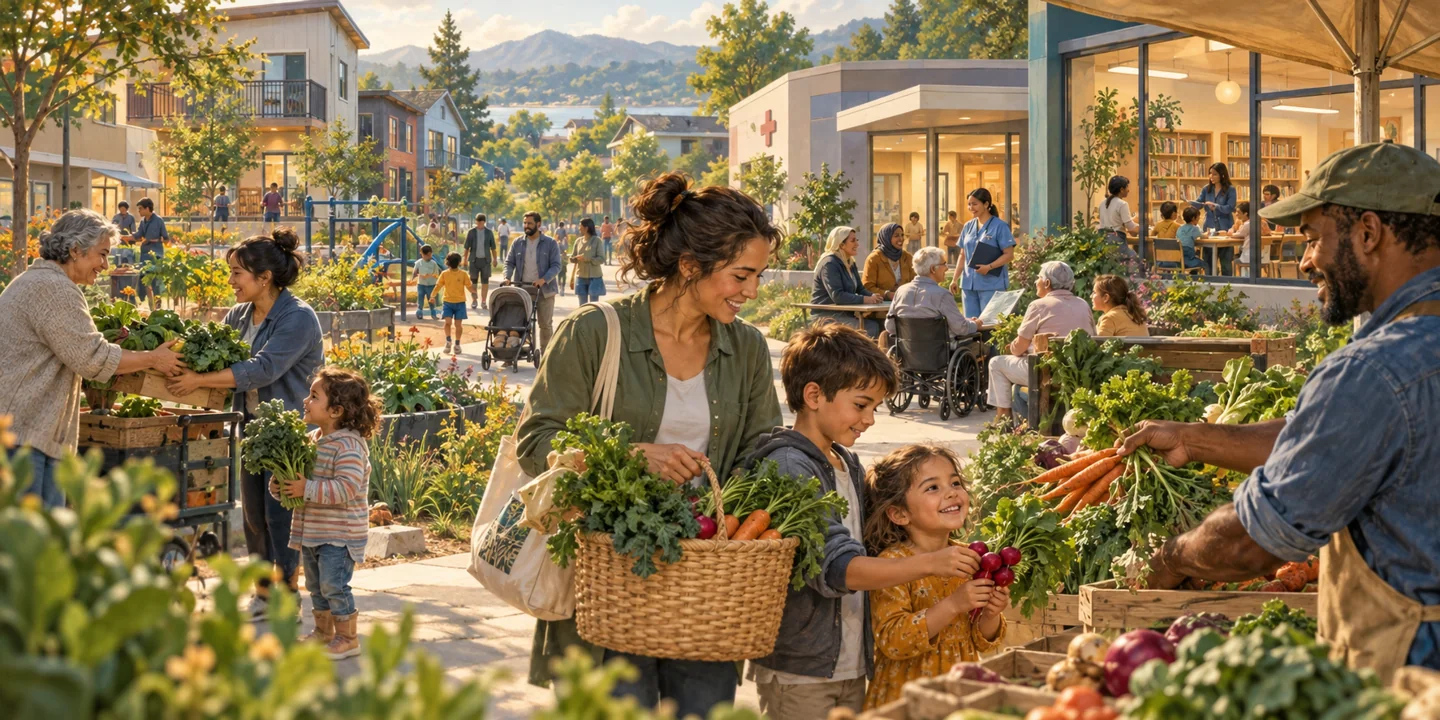
An economy should help everyone live securely, care for one another and have time to discover what makes their heart sing. How could our choices bring that closer in every country?
Basic security gives people more freedom to learn, participate and make choices.AI-created illustration of the topic; not a photograph of an actual event.
A cleaner prepares a hospital. A farmer grows food. A parent cares for a child. A driver brings supplies. A doctor treats illness. Each helps sustain our shared house. Yet a person can contribute every day and still struggle to afford necessities.
This is an invitation to examine conditions and possibilities together. Workers, employers, professionals and public servants all have experiences worth hearing. We can question an arrangement without judging the worth or motives of everyone within it.
For every house:people in Africa, Asia, Europe, the Americas, Oceania and small island communities belong in this discussion. The examples below are starting points, not a ranking of countries or a complete assessment of all 199 houses. Costs, rights, services and opportunities differ within countries too.
Published October 12, 2026. Facts link to their sources. Calculations state their assumptions. Scenarios are illustrations, not accounts of named people. Older research is identified by its year.
A legal minimum and an adequate life are different questions
A minimum wage sets a floor for covered employment. A living wage asks what an adequate standard of living costs for workers and their families. Household size, location, hours and public services matter. A law called a “National Living Wage” does not establish that every household can afford its needs.
Selected legal hourly rates checked October 12, 2026
Country
Rate and currency
Who and when
United States
US$7.25
Federal floor for covered nonexempt workers, effective July 24, 2009. Higher applicable state or local rates can govern.Source 1
Canada
C$18.15
Federally regulated private-sector employment, from April 1, 2026; a higher provincial or territorial rate prevails. Most employment is governed by provincial or territorial rules.Source 2
United Kingdom
£12.71
Workers aged 21 and over, from April 1, 2026. Lower age and applicable apprentice rates exist.Source 3
Germany
€13.90
General statutory gross hourly floor from January 1, 2026; statutory exceptions apply.Source 4
These are different currencies and legal scopes. Comparing the numbers alone cannot tell us where people live better. We need comparable take-home earnings, local prices, benefits and access to services. Other countries use national, regional, sectoral or collectively agreed wage floors; some workers fall outside effective protection.
Sourced rate and calculation · United States
Working full time and counting every dollar
At US$7.25, 40 paid hours a week for 52 weeks producesUS$15,080 a year, or aboutUS$1,257 a month before tax. This assumes uninterrupted work and excludes benefits, overtime and tips.
If we illustrate rent at US$900 a month—not a surveyed rent—about US$357 remains before taxes, food, utilities, transport or treatment. Sharing accommodation may help, but it does not create additional income.
What could help?Adequate pay together with affordable housing, accessible services and dependable hours. Ask what an actual local budget shows.Source 1
Sourced rate and calculation · Canada
A higher hourly figure still needs a local budget
At the federal C$18.15 rate, the same 40-hour, 52-week assumption givesC$37,752 annually before tax. This is not the applicable rate for every Canadian worker.
At 20 paid hours a week, the figure is C$18,876. A student's time must also cover classes, study and travel. A household’s needs do not halve because paid hours do.
What could help?Grants and affordable accommodation, alongside relevant wage protections. Measure what remains after unavoidable expenses.Source 2
How many workers are affected?
BLS found that1.0% of U.S. hourly paid workersearned at or below the federal minimum in 2024. Tips, overtime and commissions are excluded from that hourly measure. It does not count everyone earning a higher state minimum or everyone whose pay is inadequate. It is not a worldwide percentage of low-paid workers.Source 5
All these workers contribute through their work. There is no defensible single percentage measuring their share of “keeping a country running.” A separate ILO study published in 2023 found key workers represented 52% of employment across the 90 countries with data. On average, 29% of key employees were low paid, using pay below two-thirds of the hourly median—not the statutory minimum—as its definition.Source 6
Different lives, recognizable pressures
The following scenarios can arise in different countries. Their purpose is to reveal a practical problem, not to imply that everyone has the same experience or that a difficult past determines someone’s future.
Illustrative scenario · A student
Work, study and somewhere safe to sleep
A young person shares an apartment while working and studying. An evening shift clashes with class; losing the shift leaves rent short. Tuition is only one part of the cost of education.
Possible change:Flexible study, maintenance grants, affordable rooms and predictable schedules could make learning achievable. Capacity, funding and eligibility must be addressed.
Ask:Can a student without family money realistically complete this course?
Illustrative scenario · A young person without support
A cheap room is not the whole answer
Someone leaving a conflict-filled home needs shelter and dependable support. They may not have a guarantor, deposit, trusted adult or experience navigating applications.
Possible change:Safe housing, mentoring, accessible counseling and help with documents could reduce barriers without taking away the person’s choices.
Ask:What support exists for someone who cannot call home for help?
Illustrative scenario · Pregnancy without family support
Trying to protect a future while facing the present
A pregnant teenager needs timely care, safe accommodation and a way to continue learning. Shame or an unaffordable service can make seeking help harder.
Possible change:Confidential, lawful health care and nonjudgmental support, with childcare and education continuity where needed. A young person’s safety and informed choices matter.
Ask:Can help be reached without humiliation or an impossible bill?
Illustrative scenario · A parent raising children alone
The extra shift that leaves little extra money
Suppose an extra shift pays 60 local currency units, while added childcare and travel cost 50. Only 10 remains before other deductions. These are invented amounts to illustrate the calculation.
Possible change:Affordable care, dependable schedules and accessible family support could make paid work more worthwhile. Childcare workers need adequate pay too.
Ask:Does support fit the hours parents actually work?
Illustrative scenario · Illness
A covered appointment can still be out of reach
A worker can afford the consultation but cannot afford the missed shift or the journey. A rural patient may have coverage and no accessible transport.
Possible change:Paid sick leave, transport assistance, nearby care and financial protection. Coverage, available staff and practical access need to work together.
Ask:What must this person give up to obtain care?
Illustrative scenario · A tenant or worker needing legal help
A right that is difficult to enforce
A person disputes an eviction or unpaid wages. They cannot afford advice and do not understand the procedure. A right on paper alone does not resolve the dispute.
Possible change:Accessible legal aid, plain-language procedures and fair dispute resolution. Mediation needs safeguards where power is unequal.
Ask:Can someone with little money obtain a fair hearing?
Illustrative scenario · An informal worker
No customers today, no earnings today
A street seller, day laborer or self-employed repairer has no guaranteed hourly wage. Illness can interrupt earnings completely. A statutory wage increase may not directly reach them.
Possible change:Affordable social insurance, public services and practical routes to formal protection. Rules must fit small livelihoods rather than make them impossible.
Evidence:The ILO’s July 2025 report describes informal employment as the reality of about 2 billion workers worldwide.Source 7
Illustrative scenario · A farmer or fisher
Producing food without controlling its price
A producer faces uncertain harvests, fuel costs, debt and a limited choice of buyers. A high retail price does not tell us what the producer received.
Possible change:Producer cooperation, storage, fair contracts, transparent prices and appropriate insurance could improve resilience. Transport and food safety still need funding.
Ask:Where does the final payment go, and who carries the risk?
Illustrative scenario · Unpaid care and disability
Essential contribution without a payslip
Someone cares for a relative, or cannot work because of disability or illness. Their need for food, housing and belonging remains. A person’s dignity cannot depend on current earning capacity.
Possible change:Accessible benefits, respite care, inclusive work where appropriate and services that respect autonomy.
Ask:Who sustains the people doing unpaid care—and those who need it?
Illustrative scenario · A small business
The owner and employees both need security
A small shop faces rising rent, energy and finance costs while its workers face rising household bills. An abrupt new obligation can be difficult to meet.
Possible change:Predictable wage transitions, fair competition, affordable finance and support for productivity, alongside enforceable worker protections.
Ask:Can a policy improve workers’ lives while helping viable small businesses adapt?
Illustrative scenario · An island or remote community
Distance changes the price of necessities
A household depends on imported food, fuel or medicine. A shipping interruption raises costs; local wages may not follow. Communities also differ in land, water and energy constraints.
Possible change:Suitable local production, renewable energy, resilient supply routes and regional cooperation. Local production is not automatically cheaper or environmentally better.
Ask:Which dependencies can we reduce without harming the living world?
Illustrative scenario · Displacement or crisis
When the workplace and home are both lost
A displaced family may lose income, documents and access to services at once. Raising a wage floor cannot help if there is no safe workplace to return to.
Possible change:Immediate shelter and essentials, accessible documentation, lawful livelihood opportunities and support for host communities.
Ask:What must be restored first so people can make meaningful choices?
Choices already being tried in different rooms
No country provides a complete model to copy. These documented arrangements show that choices exist—and that implementation matters.
Documented policy · Canada
Sharing the cost of childcare
Canada’s public program has reduced fees for participating regulated care and works toward an average C$10 a day. The official October 2026 page reports substantial reductions, while fees and access vary by jurisdiction.
What this shows:Public funding can reduce a family’s bill. An affordable place must also be available, accessible and suitable for the family’s schedule.Source 8
Documented arrangement · Germany
Education with fewer tuition barriers
DAAD reports that state higher education institutions generally charge no tuition for bachelor’s and most master’s courses. Exceptions include some programs and fees for some international students. Semester contributions and living costs remain.
What this shows:Society can fund teaching collectively. Students also need a way to afford life while studying.Source 9
Documented experience · Thailand
Coverage and the journey to care
Thailand achieved universal health coverage in 2002. A World Bank assessment of older people found reduced financial burdens, but also barriers from transport costs and lack of caregivers, especially among poor rural older people.
What this shows:Financial protection is valuable; practical access needs attention too. This is a historical assessment, not a current survey of every Thai household.Source 10
Documented program · Brazil and regional cooperation
School meals that connect children and producers
FAO describes Brazil’s national school feeding experience as combining nutrition, public oversight and food purchases from family farming. Brazil and FAO share lessons with other Latin American and Caribbean countries.
What this shows:A public purchase can serve children and support producers together. Reliable delivery, quality, fair procurement and monitoring remain essential.Source 11
Documented support · South Africa
Security beyond paid employment
South Africa provides an older person’s grant for eligible people aged 60 and above, subject to residency and other conditions, including a means test.
What this shows:Income support can reach people outside employment. Adequacy, successful access and dependable administration must also be examined.Source 12
Documented need · United States
Making legal rights usable
LSC’s 2022 Justice Gap research found that low-income Americans received no or insufficient legal help for 92% of their civil legal problems. This measures problems, not 92% of people, and is not a criminal-defense statistic.
What this shows:Legal aid and accessible procedures deserve examination alongside formal rights. Funding, service capacity and awareness affect whether people obtain help.Source 13
Health costs are a worldwide concern. WHO and the World Bank’s 2025 monitoring report estimated2.1 billion people faced financial hardship from out-of-pocket health spending in 2022. That is a dated global estimate, not the number of people without insurance. Canada’s publicly insured medically necessary hospital and physician services differ from the U.S. arrangements; other services and access barriers still need examination.Source 14·Source 15
Why contribution and security can become disconnected
Pay reflects more than social usefulness.Bargaining power, available alternatives, ownership, training, demand, discrimination and institutions can influence rewards. The value of keeping a hospital clean is not adequately described by the cleaner’s wage alone. The ILO’s essential-work findings give us evidence to examine this gap.Source 6
Income and essential costs can move differently.Even twice a legal minimum may be inadequate for a particular household. Housing supply, transport, care costs, debt and public provision influence what earnings can buy. We need local budgets rather than an assumption that a particular wage guarantees comfort.
Prices include necessary work and sometimes avoidable burdens.USDA’s updated Food Dollar series estimates farms received 11.8 cents of each U.S. dollar spent on domestically produced food in 2024. This includes food at home and away from home. It is a gross farm return, not farm profit. The rest includes processing, transport, retail, food service and other activities—not simply intermediary profit.Source 16
We can ask which services provide value, which costs could be reduced, whether competition is effective and whether producers and workers receive fair rewards. A margin needs evidence before we label it excessive.
Insecurity can consume attention.In the scenarios above, arranging food, rent and care leaves less time for study, family or creativity. People’s responses differ. Hardship does not make someone incapable, determine their character or establish a personal or spiritual failure.
Replacement sales can conflict with durability.When repair is expensive or parts are unavailable, a family may replace a useful product. Where design deliberately limits life, incentives deserve scrutiny; not every failure establishes deliberate obsolescence.Explore durability and economic choices.
What might an economy serving everyone make possible?
We propose measuring success by whether people can meet essential needs, participate and have time to live, while protecting the ecosystems that sustain us. Equal dignity and access to essentials are our starting principles. Communities can debate pay differences, training and responsibility without accepting that necessary workers must live in insecurity.
Secure essentials
Adequate wages and income support could work alongside affordable housing, nutritious food, care, education and justice. Services require skilled people and stable funding even when free at the point of use.
Check:Who pays, who qualifies, can supply meet demand, and are services reachable?
Time for family and discovery
Predictable hours, paid leave and gains in productivity could create more room for parenting, rest, learning and interests. Shorter working time needs sector-specific planning so essential services continue.
Check:Do take-home income, service quality and workloads improve?
Fairer rewards and a voice
Collective bargaining, fair contracts, producer cooperation and worker participation could strengthen people’s ability to influence conditions. Transparent accounts help people examine where value goes.
Check:Are people free to participate, are protections enforced, and do benefits reach those with least influence?
Progress shared with workers
Automation could reduce dangerous or repetitive work. Training, income protection and sharing productivity gains could help people benefit from that change. Technology alone does not guarantee an equitable result.
Check:Who gains time and income, who loses a livelihood, and what transition is provided?
Repair and responsible production
Repairable products, accessible parts and less waste could reduce household costs and material demand. New business models and training could support workers as industries change.
Check:Are total costs and environmental impacts lower over the product’s life?
Cooperation across the house
Countries could share useful knowledge, improve fair supply chains and help fund resilient essential services. Cooperation must respect local voices and avoid shifting harm to another community.
Check:Does this help the wider living world as well as our own room?
These are possibilities to evaluate, not promises of a life without any stress. Implementation should track affordability, employment, hours, prices, waiting times, public finances and environmental effects. Listen to the people whose experience challenges the first plan, and revise it.
Michael’s perspective and everyone’s freedom
Michael understands nature’s gifts as freely given by Source, and sees their responsible use as a service to humanity and all life. This is his spiritual perspective. He asks no one to believe his words; he invites people to look within, examine their experience and find their own truth.
Spiritual awareness or religious belief is not required to consider consequences, recognize suffering or treat people fairly. Everyone may hold different beliefs. Our shared invitation is to examine choices that support peace and well-being. A common purpose can accommodate different cultures, ideas and solutions.
Bring your room into the conversation
A person reading another country’s example may recognize their own struggle. Translation can help that recognition become dialogue. Local experience and verifiable evidence can then improve the picture.
Choose one situation you know: rent, food, work, care, education or access to justice.
Describe the pressure without identifying anyone who has not agreed to be identified.
Add a dated local source where possible. State the currency, location, household and hours behind any calculation.
Describe a change that helped—or explain why a proposed solution failed.
Ask what we could learn together, including consequences for other rooms and the living world.
You may contribute without displaying your name. Keep identifying, medical, financial and other sensitive details out of public posts. Available assistance depends on location and eligibility.
The people sustaining our shared house should have a place in deciding how it works. What would change if every room asked whether its choices helped everyone live with dignity, security and freedom?
Check the evidence
Sources checked October 12, 2026. Publication and data years are retained above; rules and programs can change. Linked figures do not establish a complete assessment of any country.
Help improve translations. Join our community team.
We warmly welcome help from people who are fluent in the languages used here. These AI-assisted translations may contain mistakes or miss cultural nuances. Your knowledge can help preserve the meaning, tone and intent of the message for readers around the world.
Please send us the page or document, quote the wording that needs attention, and suggest a correction with a brief explanation. A single correction is valuable. You can also volunteer to review more content and become part of our volunteer community team.
If you support Governing for Life’s purpose—improving the well-being of people and the living world—we also welcome volunteer moderators and community mediators. Moderators help apply the participation guidelines fairly. Mediators help keep communication polite and respectful, make room for different viewpoints, and avoid using their role to promote personal opinions. Supporting the purpose does not require agreement with every article or perspective.
Choose the kind of help and the time commitment that suits you. Together, people from different countries, languages and experiences can help this worldwide conversation grow.