Our shared home · Our shared possibilities
World Peace: Every Room Has Something to Offer
Humanity’s shared inheritance—and what we can build together.
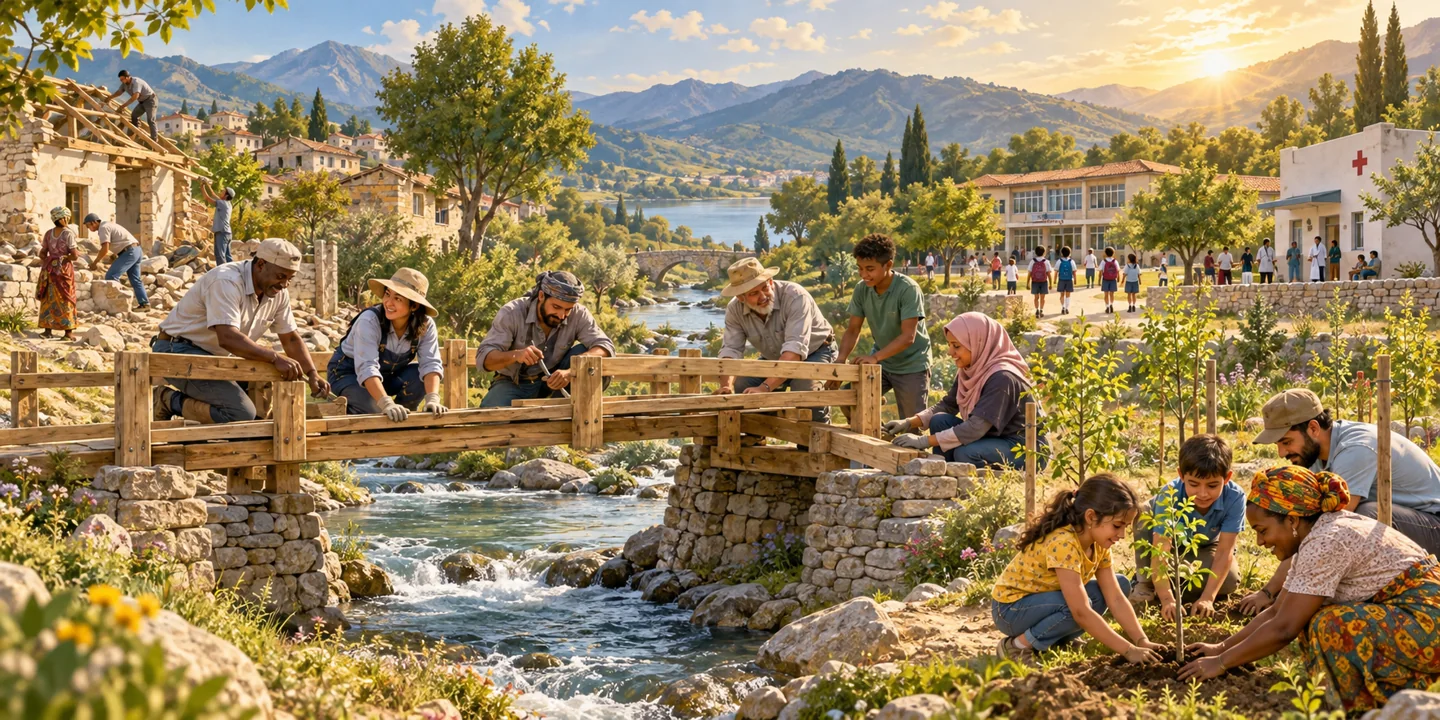
Our purpose is to promote world peace by helping people everywhere communicate, share their understanding and work together. Today’s technology gives us an unprecedented opportunity to connect across the world and organize our shared resources and abilities so everyone’s essential needs are met—giving people greater freedom to enjoy life, learn, create and contribute to the well-being of our shared home, planet Earth.
Picture Earth as one house, with countries as its rooms and communities as rooms within them. One room may grow food; another may develop a medicine, preserve seeds, create music or teach a skill. None contains everything. What happens in one room affects the others.
World peace becomes more than a phrase when we organize daily life around that understanding. A child should not have to go hungry because the resources, knowledge and willingness to help exist somewhere else but cannot reach them. Connecting those possibilities is a task humanity can choose to undertake.
Our lives already contain contributions from other rooms
These are starting examples, not a ranking of peoples. Ancient societies did not follow today’s borders. Inventions often emerged through generations of observation, adaptation and exchange; credit belongs to more people than the famous names we remember.
Food: knowledge carried through generations
Maize domestication began in what is now Mexico. Smithsonian research describes how its development continued as cultivation spread into South America. Indigenous and traditional farmers helped shape the varieties that became a global food resource. A meal can carry knowledge accumulated by people we have never met. Read the Smithsonian research account.
Paper, printing and the movement of ideas
Paper-making and printing techniques spread along the Silk Roads, linking societies across Asia and beyond. Merchants, craftspeople and travellers carried skills as well as goods. The ability to record and circulate knowledge made learning available beyond a single teacher or place. UNESCO explains these exchanges.
Mathematics: a shared language for practical work
The decimal place-value system developed in India and was transmitted through Arabic scholarship into Europe. Its history also includes earlier numerical traditions and debated pathways of influence. Calculations used in construction, trade and science inherit that shared history. Explore the University of St Andrews history of Indian numerals.
Medicine: discovery needs collaboration
The 1945 Nobel Prize recognized Alexander Fleming, Ernst Chain and Howard Florey for penicillin and its use against infectious diseases. Turning a discovery into treatment required further investigation and production work. The lesson extends beyond medicine: a useful idea needs people, equipment and systems that make its benefits accessible. Read the Nobel Prize record.
Music: creativity crosses boundaries
Jazz grew in New Orleans from traditions including blues, ragtime and African music. It became a form of expression embraced around the world. UNESCO’s International Jazz Day uses that shared creativity to encourage dialogue and peace. Art offers something essential too: opportunities to listen, connect and imagine another way of living. Read UNESCO’s account of jazz and its roots.
The Web: an idea that helps connect our house
Tim Berners-Lee developed the World Wide Web at CERN to support information-sharing. CERN released its Web software into the public domain in 1993 and later under an open licence. That decision helped others build upon it. The Web is one part of the larger Internet; its history illustrates how access rules can influence the reach of an invention. Read CERN’s history.
A person’s value does not depend on inventing a famous technology or owning a valuable resource. Raising children, caring for neighbours, repairing equipment, preserving local knowledge and creating beauty also sustain our shared house.
The same capacity can serve life—or harm it
Innovation does not choose its own purpose. The rules, incentives, ownership and decisions surrounding it matter.
Industrial ammonia synthesis provides a concrete example. Haber’s work and its industrial development enabled production of nitrogen fertilizer; the same chemical capacity also supported explosives production. The Nobel biography describes both uses. The contrast asks us to examine what a system rewards, not condemn a whole country or scientific field.
Likewise, communication tools can support learning and cooperation, or be used for fraud, intimidation and misleading information. AI can help examine infrastructure and compare solutions, or support coercive surveillance and weapons. These are examples of possible uses, not a claim that every system behaves alike.
Questions that reveal the bigger picture
- Who decides how this invention or resource is used?
- Who receives its benefits, and who bears its costs?
- Do ownership, prices, contracts or access rules exclude people who need it?
- Can affected communities challenge decisions and obtain a remedy?
- Which changes would preserve useful work while reducing harm?
Companies can benefit from sales, governments from strategic power, and owners from controlling access. Those benefits are not automatically harmful. Problems arise when rewards depend on exclusion, exploitation or damage whose costs fall on others. Claims about wrongdoing need evidence about specific actions, contracts and decisions.
Possible responses include transparent procurement, enforceable environmental standards, independent oversight, fair competition, appropriate technology licensing and public or cooperative services. Their value should be judged by what they deliver for people and ecosystems.
Some rooms are already choosing cooperation
These documented initiatives show practical elements of a different direction. They do not establish that world peace or equal access has already been achieved.
Protecting one atmosphere
The Montreal Protocol created an international framework for phasing out ozone-depleting substances, supported by scientific assessment and assistance with the transition. It shows how a shared environmental problem can produce shared rules and sustained cooperation. Explore the agreement and its institutions.
Protecting the diversity of our food
The Svalbard Global Seed Vault holds more than 1.4 million seed samples as of 2026. Norway, NordGen and the Crop Trust work together to safeguard backup collections from around the world. Depositors retain ownership of their seeds. This protects options for future agriculture; it does not by itself deliver food to hungry people. Read about the Seed Vault.
Sharing the ability to make health technologies
WHO’s mRNA technology-transfer programme links a South African hub with partners across its six regions, including Argentina, Bangladesh, Brazil, Egypt, India, Indonesia, Kenya, Nigeria, Pakistan, Senegal, Serbia, Tunisia, Ukraine and Viet Nam. Building local capability can reduce dependence on a few suppliers. Technology transfer still requires funding, trained staff, regulation and successful product development. Explore the programme.
Connecting energy resources
IRENA’s Africa Clean Energy Corridor initiative promotes renewable-energy development and cross-border electricity trade in eastern and southern Africa. Its approach recognizes that resources and demand do not stop at borders. Reliable connections, fair agreements and ecological assessment are necessary to turn that potential into dependable access. Read about the initiative.
Connecting Our Rooms: A Practical Proposal
We propose starting with a simple question: What do people need, what can we contribute, and what prevents those two things from meeting? Infrastructure includes institutions, skills and dependable services as well as roads, ports and cables.
Food and clean water
Illustrative example: A farming community has seasonal produce while a nearby town struggles to obtain affordable food. Residents could investigate storage, safe processing, transport and purchasing agreements. Water engineers and local knowledge could help assess irrigation and drinking-water needs together. A plan must account for drought, soil health, food safety, staffing and who pays for maintenance.
Housing and material reuse
Illustrative example: A town has unused buildings and people needing homes. Begin by establishing ownership, building condition and reasons for vacancy. Compare repair, safe material recovery and new construction. A community land trust, cooperative or public programme could be assessed for lasting affordability. Planning must include contamination checks, legal rights, accessibility and ongoing stewardship.
Energy and essential services
Illustrative example: Communities with different wind, solar or other suitable resources could examine shared generation, storage and connections. Hospitals, water systems and food storage need reliable power during extreme weather. Compare the whole cost, resilience and environmental effects of alternatives—not only the cheapest initial installation.
Education, repair and creative life
Illustrative example: A community learning centre connects young people and adults with farmers, artists, scientists and repair workers. Learning follows interests while providing essential foundations and freedom to change direction. Participation can strengthen community life without replacing paid workers with unpaid labour or restricting a child’s choices.
Information that people can actually use
Connect local inventories of needs, skills and resources through accessible websites, telephone services and places to meet in person. Translation can bring more voices into the discussion. AI can help organize information, compare options and identify gaps; people must verify its outputs and retain authority over decisions. A connection on a screen is useful only if it leads to workable arrangements on the ground.
Make the transition fair
Within today’s economic systems, building and maintaining these services creates work. Funding can combine public investment, community ownership, responsible private enterprise and cooperative finance. Workers in declining industries need credible training, income support and opportunities—not an instruction to absorb the whole cost of change.
Longer-term arrangements can explore sharing resources and reducing dependence on profit as the gateway to essentials. They still need practical rules for shortages, maintenance, allocation, accountability and ecological limits. Essential care should not depend on a person’s ability to work.
Give every project an accountable plan
- Identify the need and ask the people experiencing it.
- Map available resources, skills and existing services.
- Explain the obstacles: finance, law, capacity, access or environmental limits.
- Agree who will fund, deliver, maintain and oversee the change.
- Measure access, reliability, health, environmental effects and time freed for life.
Start with a manageable project, publish what worked and what failed, and let other communities adapt it. Cooperation should increase freedom and security while respecting people’s rights, culture and ability to disagree.
What kind of house are we handing to our children?
Continuing practices that damage life carries consequences. Choosing cooperation also requires work: changing incentives, resolving disagreements and building systems that endure. We can examine those choices without treating our neighbours as enemies.
Meeting essential needs alone will not resolve every cause of conflict. Peace also requires protection from violence, fair treatment, accountable institutions and ways to settle disputes without war. The purpose is to connect these efforts so that more people can live securely and explore their abilities.
World peace is the direction we are inviting humanity to work toward—through informed choices, nonviolence and shared responsibility for our home.
What could your room contribute?
You do not have to solve the whole problem to ask about it. Your experience matters.
- What need in your community is going unmet?
- What knowledge, resource or practical example could help another community?
- Which rule or missing service prevents a useful solution?
- What could people build together, and how would we know it helped?
Ask a question Join the discussion Explore the country houses
Share sources where possible, and tell us when an example needs correcting. These are invitations to dialogue; this website does not yet operate the proposed resource-sharing services.
Historical and programme sources checked 11 October 2026. Practical scenarios and recommendations are proposals from this human–AI dialogue. Contributions and corrections are welcome.