One shared home · Equal respect · World peace
The United Nations and a More Peaceful World
What humanity built, what limits it, and what we could choose to change.
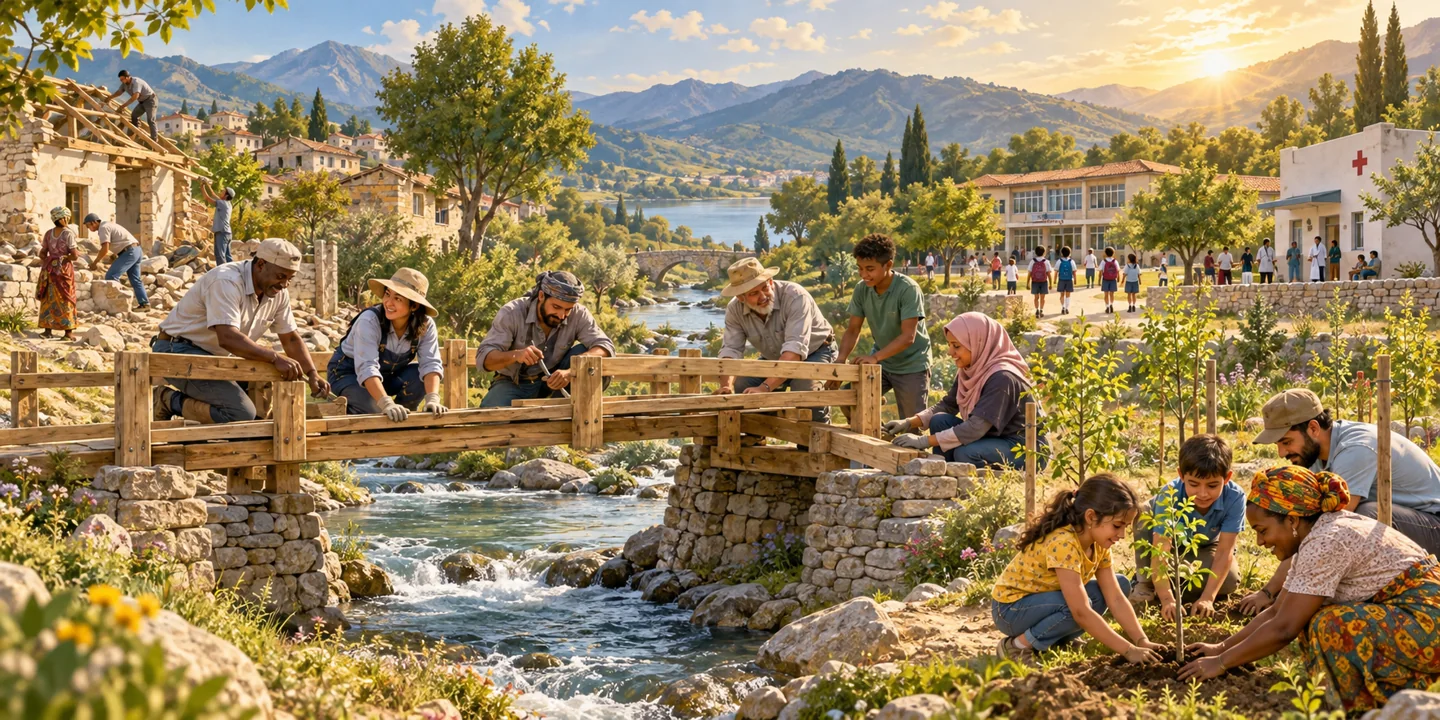
World peace requires dependable ways to resolve disagreements and cooperate across borders. It also requires attention to the conditions that leave people struggling to survive. This discussion examines the United Nations alongside fair compensation, manufacturing and the protection of children.
Our purpose is to question arrangements and consequences without assigning collective blame to a country, population or belief system. Documented facts are linked to sources; reforms below are proposals from Michael and Elarion’s dialogue, not descriptions of powers the UN already possesses.
Why the United Nations came into existence
The UN emerged from the destruction of the Second World War and the failure to prevent it. It formally began on 24 October 1945. Its Charter set purposes including maintaining international peace and security, peaceful dispute settlement, cooperation and human rights. UN history · Charter purposes.
The earlier League of Nations had failed to prevent another world war. The new institution sought collective security with the major powers inside it. Permanent Security Council seats and veto powers formed part of the political settlement. Understanding that compromise explains its origins; it does not establish that the same distribution of power remains suitable for humanity’s future. Explore the founding negotiations.
The question is whether arrangements inherited from that period now serve the whole planetary house—or permit a few rooms to block decisions affecting many others.
What the current system offers and what obstructs it
A place to keep communication open
The UN provides continuing institutions for diplomacy, agreements and cooperation. Its wider system includes humanitarian, health and other specialist organizations with their own responsibilities and governing arrangements. Maintaining channels of communication matters even when governments disagree. Explore documented cooperation.
Equal votes do not mean equal authority
Each member state has one vote in the General Assembly. Many of its decisions on international affairs are recommendations. The Security Council has different powers: member states are obligated under the Charter to carry out its decisions. General Assembly provisions · Security Council responsibilities.
China, France, Russia, the United Kingdom and the United States hold permanent Council seats. A negative vote by any of them can block a substantive resolution; procedural decisions follow different rules. A veto does not stop every UN activity, and a permanent member’s abstention is not a veto. Read the voting rules.
Benefit of the founding compromise: it sought to keep major powers participating in collective security. Cost: exceptional blocking power can prevent collective action when a permanent member opposes it. A government’s strategic interests may diverge from the protection people need.
Responsibility without dependable resources
Missions need personnel, equipment, financing and a workable political process. UN peacekeeping reporting identifies mismatches between mandates and resources, along with divisions among member states. Promising protection without the capacity to deliver it undermines trust. Read the March 2025 account.
Consent and political cooperation
Conventional peacekeeping rests on consent of the main parties, impartiality and limits on force. It cannot automatically replace a political settlement. Resistance, obstruction and lost consent can make a mission ineffective or unsafe. Peace enforcement without consent is a different undertaking. Explore the principles.
Accountability for the institution itself
Misconduct, including sexual exploitation and abuse, harms people and damages confidence. Military contingents generally remain under the exclusive criminal jurisdiction of their national government. This makes effective investigation and action by contributing countries essential. Accountability must protect victims, not merely the reputation of an institution. Read the conduct and jurisdiction provisions.
Administrative delays, overlapping responsibilities and inadequate transparency should also be examined through specific evidence. Not every failure has the same cause, and no single reform resolves them all.
A childhood vision of shared peacekeeping
Michael recalls being excited by the UN as a young boy in Canada. He imagined a world in which the only military force existed collectively to protect peace, with participation from every country. That recollection introduces a question about what humanity could build together.
Canada’s peacekeeping reputation has a documented foundation. Lester Pearson helped bring about the United Nations Emergency Force during the 1956 Suez crisis. Canadian personnel contributed to that work. Canada’s armed forces also had other responsibilities; peacekeeping was not their only role. Read Canada’s account of the mission.
The larger invitation is to examine how people could move from competing preparations for war toward dependable protection of peace.
Equal standing without permanent privileges
Our proposed direction is equal standing for countries regardless of their economy, military or size, with no permanent national veto. Equal dignity for people must accompany equal national standing.
- Representative global authorization: major collective-security decisions would be authorized through an agreed representative process, with published evidence, reasons and voting records.
- Administration with limited delegated powers: a rotating body could coordinate implementation and urgent tasks without acquiring permanent national privileges or unchecked authority. Terms, emergency powers and review deadlines would be defined.
- Rights beyond majority preference: an international majority must not be free to authorize persecution or remove fundamental protections. Independent legal review and remedies would apply.
- People as participants: affected communities, Indigenous peoples, workers and young people need meaningful opportunities to contribute alongside governments. A complementary representative chamber or structured public process could be explored.
- Independent oversight: investigators, courts and auditors should be able to examine powerful governments and the international institution itself.
One country one vote gives national equality but not equal influence per person: populations differ greatly. A second representative channel could address that tension without granting privileges for wealth or military strength. Its design should be debated openly rather than assuming either voting formula is automatically fair.
Participation across all levels should be accessible through translation, fair recruitment, training and financial support for countries with fewer resources. Shared standards of competence and conduct remain necessary. Equal opportunity to contribute is not a claim that every country must provide an identical number of personnel in every role.
A shared international peace and protection service
A reformed service could bring together mediators, civilian protection specialists, medical teams, engineers, disaster responders and appropriately trained peacekeepers. The aim would be to prevent violence, protect people and support recovery.
Today the UN has no standing army or police force of its own; member states contribute personnel for missions. Article 43 also envisages special agreements concerning forces and assistance made available for collective security. These provisions are not the worldwide force Michael proposes. How operations are formed · Article 43.
What a new arrangement would require
- Civilian authority, clear legal mandates and public accountability.
- Common training and equipment standards, with dependable logistics and financing.
- Independent investigations, effective prosecution arrangements and remedies for victims.
- Protection of civilians, defined limits on force and review of emergency action.
- Participation by affected communities in planning, assessment and recovery.
- Verifiable arms-control and disarmament agreements, with a realistic transition for national services and workers.
Concentrating all armed power in one institution would also concentrate the damage possible if it were misused. Separate oversight functions, rights of appeal and enforceable limits must therefore be built into the design. The ability to protect peace must not become an unrestricted ability to impose a powerful group’s preferences.
Reducing national armed forces would depend on credible collective protection and lawful agreements. It could not safely be assumed before those conditions exist. A future shared system would also need to address existing treaty commitments and the Charter’s current provisions on self-defence.
Peace also requires fair economic arrangements
Michael proposes standardized compensation for comparable work, so a person’s location does not become a reason to exploit them. He connects this to production moving between countries and communities losing skills, jobs or essential manufacturing capacity.
Lower labour costs can influence relocation. Wages alone do not explain every decision: productivity, machinery, energy, suppliers, transport and market access also matter. International production can bring employment and useful exchange, while leaving benefits unevenly shared. Explore research on global production networks.
Identical amounts converted into one currency do not guarantee identical living standards. Food, housing, public services and purchasing power vary. The ILO’s living-wage approach considers workers’ and families’ needs within country circumstances. Read the living-wage approach.
A practical direction to examine
- Comparable work receives fair compensation, with a dependable standard of living and transparent methods of comparison.
- Enforceable protections cover working time, safety, discrimination and the ability to organize and bargain collectively.
- Buyers and contractors take responsibility for labour conditions throughout their supply chains.
- Transition support helps workers and communities when standards or production arrangements change.
- Countries maintain and develop essential skills and resilient regional supply capacity alongside dependable international cooperation.
The purpose is to remove incentives for exploitation while improving people’s lives. Abruptly imposing a wage level without addressing productivity, funding and transition risks could eliminate jobs or expand informal work. A credible plan would identify how rising standards are financed and how workers remain protected.
Resilience need not mean every country making every product. Diversified supply, local repair capacity and fair shared agreements can help communities avoid dependence on a single company, supplier or route. Environmental costs should be examined alongside financial costs.
Children must not bear the hidden cost
Cheap goods can conceal hazardous work, interrupted schooling and lost opportunities for children to play and develop their interests. The 2024 ILO–UNICEF estimates, released in 2025, put child labour at nearly 138 million children, including around 54 million in hazardous work. These are estimates for 2024, not a real-time count. Read the estimates.
Child labour also occurs outside export supply chains. Preventing it requires looking at household poverty, public services, conflict and the conditions in different sectors—not assuming every case is caused by international manufacturing.
Age-appropriate learning and safe contributions to family or community life are different from work that harms children or interferes with schooling. Learning alongside a farmer or craftsperson should be voluntary, safe, suited to the child’s age and compatible with education. It must not become a substitute for paid adult labour.
- Adults need decent livelihoods so survival does not depend on children’s earnings.
- Children need accessible education, including support for transport and other barriers.
- Enforcement must address employers and supply-chain responsibilities rather than punish the child.
- Withdrawal from harmful work should include food, family support, education and appropriate care.
- Children’s views should inform decisions affecting them, with protection from retaliation.
The ILO identifies decent adult employment, poverty reduction, education and social protection as connected measures. Removing a child from a workplace without addressing the underlying need can leave the problem intact. Explore prevention measures · Education and children.
What humanity would need to change
A country passing its own law cannot by itself abolish the Security Council veto or authorize a new worldwide force. Reform needs coordinated international agreement and the relevant national constitutional processes.
Article 108 requires Charter amendments to be adopted by two-thirds of General Assembly members and ratified by two-thirds of member states, including every permanent Security Council member. The Charter-review route in Article 109 likewise retains a permanent-member ratification requirement for resulting changes. This is a substantial political obstacle, not a reason to pretend reform is already legally available. Read the amendment and review provisions.
Changes that can support progress now
- Require transparent explanations and scrutiny of blocking decisions. The 2022 General Assembly veto initiative provides debate after a veto; it does not override one. Read the resolution.
- Match mandates with realistic resources, evaluate programmes and publish findings.
- Improve accountability for misconduct and make protection and remedy accessible to affected people.
- Expand meaningful public participation and language access.
- Strengthen labour protections and family support through agreements and domestic implementation.
- Build support for Charter reform through public discussion, diplomacy and lawful national processes.
A negotiated framework could define common minimum protections while allowing countries to retain their languages, cultures and suitable local arrangements. Cooperation does not require everyone to think alike or surrender the right to disagree.
How we would judge success
Measure whether violence and displacement decline, civilians receive protection, assistance reaches people and grievances receive timely remedies. Examine access to food, water, medical care and education; working conditions and child labour; and the health of ecosystems.
Publish costs, results, failures and corrections. Faster decisions are valuable when they improve outcomes, not merely when they bypass scrutiny. AI can assist with translation, comparing evidence and identifying gaps, but its outputs require verification and accountable human decisions. It must not become a new source of unchallengeable authority.
The standard is whether the system serves people and the living world rather than preserving the exceptional power of a few. World peace is the purpose; equal respect, participation and practical cooperation are ways to work toward it.
Questions every room can ask
- Can my government explain how its international decisions protect people beyond its borders?
- Should any country retain a permanent veto over collective protection?
- How can countries have equal standing while citizens also have meaningful representation?
- What safeguards would make a shared peace service trustworthy?
- Do the products we buy depend on unsafe work or exploitation of children?
- How can higher labour standards improve livelihoods without abandoning workers during the transition?
- What could we do in our own community to strengthen cooperation and peace?
Ask a question Share evidence or a perspective Find ways to contribute
Sources checked 11 October 2026. Michael’s recollection and the proposed reforms are identified separately from current rules and documented evidence. We welcome challenges, corrections and alternative proposals.