Measure well-being alongside GDP
Track health, secure housing, equal access to quality education and training, useful time, ecological condition and long-term resilience alongside output and income. Publish the trade-offs.
What governments can reward, measure and put into practice.
Consider a parent comparing two government proposals. One promises more economic activity; another promises cleaner water, reliable transport and accessible training. The practical question is what each proposal would change in the family’s daily life, at what cost, and for how long.
No country can solve global problems alone. Governments can cooperate across differences while remaining accountable to their own people.
Track health, secure housing, equal access to quality education and training, useful time, ecological condition and long-term resilience alongside output and income. Publish the trade-offs.
Support repairable design, spare parts, durable software, reuse and responsible recycling. Let public purchasing help create markets for longevity.
Use transparent impact assessments and suitable rules for pollution, restoration and producer responsibility. Protect low-income households as policies change.
Share evidence, align useful standards, protect communities affected by transitions and build practical agreements on climate, trade and technology.
Canada’s trade and energy choices are one example of this tension: diversification and cooperation can improve resilience, while new projects still need honest assessment of ecological and community costs.
A resident trying to repair an appliance, a young person seeking training, and a parent looking for reliable childcare all encounter the effects of public decisions. Begin with those experiences, then examine the evidence and the wider consequences. A proposal deserves to be judged by what changes for people and the living world.
For any policy or product, ask what useful service it provides, how long it lasts, and who bears its full cost.
Test repair rules, well-being measures and fair transition policies. Publish results, including failures, and change course when evidence demands it.
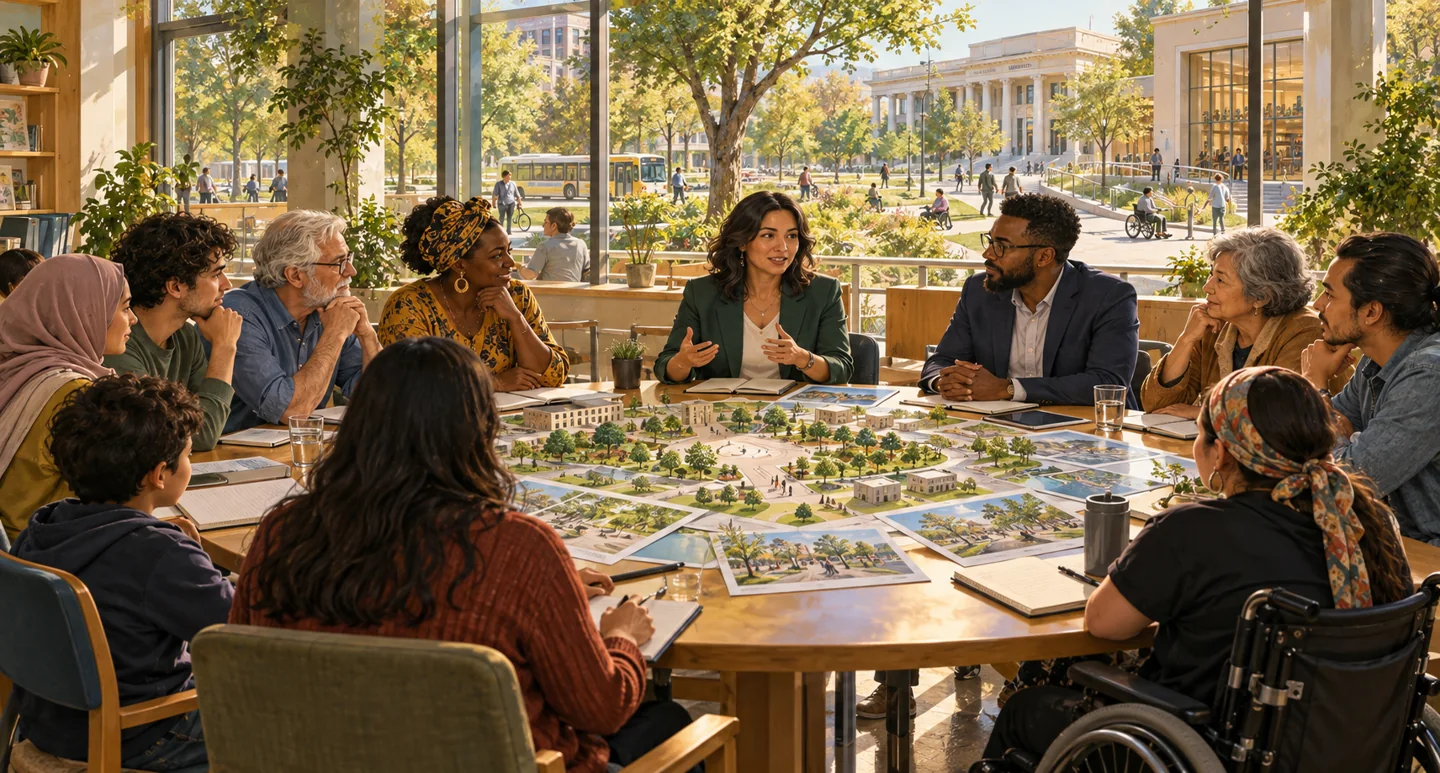
Invite people with different priorities to define the problem together. Cooperation begins with a shared picture of reality, not forced agreement.
Drawn from the Governing for Life discussion paper. Linked references open the supporting sources.
Election cycles, quarterly earnings and annual budgets encourage attention to immediate results. Climate systems, forests, soils, infrastructure, public health and resource depletion operate over decades. Future generations cannot vote in today's elections, and ecosystems do not participate directly in markets. Governance therefore needs mechanisms that deliberately represent long-term consequences.
A national dashboard could place conventional economic indicators beside measures of present and future well-being. The OECD already maintains a well-being framework, and UNDP's Planetary Pressures-adjusted Human Development Index adjusts human-development performance for carbon emissions and material footprint. These demonstrate that broader measurement is practical, not merely philosophical.
Quality education is part of durable well-being in its own right. A place in a classroom is a limited measure if teaching is inadequate, essential equipment is missing or a learner cannot afford to remain. The proposed dashboard would report opportunity and quality together, with results by income, disability, location and age where data permit. Equal access means a fair opportunity with appropriate support; it does not require identical interests, pathways or outcomes.
Future generations and non-human life cannot bargain directly in today's institutions. Governments can compensate by requiring long-term impact statements, independent future-generations offices, natural-capital accounts, intergenerational fiscal analysis and ecological thresholds for decisions with irreversible effects.
This would not give an abstract concept veto power over elected governments. It would force present decision-makers to make long-term consequences visible before acting.
Complex transitions create legitimate disagreements. Energy security, employment, affordability, environmental protection and industrial competitiveness can pull in different directions. A governance culture capable of stating the strongest case on each side, acknowledging uncertainty and seeking shared gains is better suited to these problems than a culture that treats disagreement as disloyalty.
Principle | Question | Possible instrument | Guardrail |
|---|---|---|---|
Life first | Does this improve durable well-being? | Beyond-GDP dashboard | Keep economic output visible |
Long-term stewardship | What is transferred to the future? | Future-impact assessment | No unelected veto |
Circularity | Can value remain in use longer? | Repair/durability rules | Technology-neutral where possible |
True costs | Who pays for harm? | Lifecycle accounting | Protect affordability |
Shared prosperity | Who receives productivity gains? | Tax/benefit/ownership reform | Preserve incentives to innovate |
Evidence | Did the policy work? | Independent evaluation | Publish data and assumptions |
Pluralism | Can disagreement improve the design? | Deliberation and pilots | Protect rights and dissent |
Global cooperation | Can the problem cross borders? | Standards and coalitions | Respect national autonomy |
Imagine a family whose safety depends on help crossing a border or on violence stopping nearby. A debate about institutional rules becomes very personal: can people reach shelter, food, medical care and protection? This illustrative situation gives a human starting point for Michael’s earlier discussion of a more effective United Nations.
The earlier essays “Message to United Nations” and “Five Pillars of a Reimagined United Nations” propose stronger protection of civilians, fairer international decision-making, predictable funding, wider public participation and a voice for ecosystems and future generations. These are reform proposals, not descriptions of powers the UN already possesses.
The Security Council’s permanent members can veto substantive decisions; procedural decisions follow a different voting rule. A veto is not a power to block every action of the entire UN. Read the Council’s voting rules.
Changing Charter provisions is a major legal and political undertaking. Article 108 requires adoption by two-thirds of General Assembly members and ratification by two-thirds of UN members, including every permanent Security Council member. Read Article 108.
UN peacekeeping currently relies on military and police personnel voluntarily contributed by member states. Its financing includes assessed contributions, rather than depending only on voluntary donations. A proposed standing peace service or new funding mechanism must therefore explain how it would differ from existing arrangements. Read how peacekeeping is funded and staffed.
Who authorizes an intervention? How are civilians protected and abuses investigated? How can smaller countries influence decisions? Who funds the work, and what happens if contributions are withheld? How are youth, Indigenous peoples and affected communities heard without replacing democratic accountability? A proposal should address these questions before promising that a new institution will bring peace.
The practical starting point is cooperation on specific needs, transparent decisions and independently examined results. More ambitious changes require negotiation, legal authority, safeguards and sustained public support.
Questions for candidates · Costs to households and ecosystems

No single political system tells the whole story of human governance. Institutions have changed as people organised, challenged exclusion, negotiated rights and revised rules. Some inherited arrangements solve real problems; others need reconsideration. Our aim is to examine outcomes and opportunities, rather than judge entire parties, governments or populations.
Participation can extend beyond elections to public consultations, local decisions, citizen panels and oversight. The OECD’s 2020 review examines representative deliberative processes used by public authorities for complex questions, including climate and infrastructure. It identifies opportunities to improve decisions and trust, alongside the need for thoughtful design and evaluation.
OECD: Innovative Citizen Participation and New Democratic Institutions (external source)
A concrete example is Ireland’s 2022 Citizens’ Assembly on Biodiversity Loss. The OECD’s 2025 review describes how it helped strengthen the public mandate for action and government support for nature restoration. This illustrates a possible contribution from deliberation, not proof that every assembly or recommendation succeeds.
OECD: Climate governance and citizen participation (external source)
Ask who can take part, what information they receive, whether disagreement is welcome, how decisions are made and how consequences will be assessed. Participation should be an opportunity people can choose, with realistic ways to influence outcomes.
People with connectivity can now exchange information across countries in moments, at a scale unavailable to earlier generations. This does not mean every person can participate equally: ITU estimated that 2.2 billion people remained offline in 2025. Accessible information, language support and opportunities beyond the internet remain important.
ITU: Facts and Figures 2025 (external source)
Share experiences and suggestions · Examine information fairly · Help nurture the conversation
Our familiar surroundings are connected to people, institutions and living systems far beyond them. Read The House With Many Rooms and explore what those connections mean.
Explore why the UN was created, what limits its work and proposals for equal participation, accountable peacekeeping, fair work and protection from child labour.
Examine restrictions, recent evidence, collective action and practical ways to make equal rights real.
Explore documented international cases and the wider conditions that allow exploitation: power, insecurity, institutional failures, and the changes needed to protect dignity and freedom.
Read the full illustrated articleWe warmly welcome help from people who are fluent in the languages used here. These AI-assisted translations may contain mistakes or miss cultural nuances. Your knowledge can help preserve the meaning, tone and intent of the message for readers around the world.
Please send us the page or document, quote the wording that needs attention, and suggest a correction with a brief explanation. A single correction is valuable. You can also volunteer to review more content and become part of our volunteer community team.
If you support Governing for Life’s purpose—improving the well-being of people and the living world—we also welcome volunteer moderators and community mediators. Moderators help apply the participation guidelines fairly. Mediators help keep communication polite and respectful, make room for different viewpoints, and avoid using their role to promote personal opinions. Supporting the purpose does not require agreement with every article or perspective.
Choose the kind of help and the time commitment that suits you. Together, people from different countries, languages and experiences can help this worldwide conversation grow.
Send a correction or express interest in joining the team · Explore volunteer team roles